Introduction
Fire safety has become a major concern in both residential and commercial construction, and choosing the right fire-resistant building material is more important than ever. Among the many options available today, two materials often draw attention: fireproof plasterboard and magnesium oxide board, also known as MgO board. Although both are used to slow down the spread of fire and improve building safety, the way they perform, their durability, and their suitability for different environments can vary significantly.
Fireproof plasterboard has long been a standard choice in interior wall and ceiling systems. It is widely available, easy to install, and familiar to most contractors. On the other hand, MgO board is a newer, inorganic, high-performance option that offers strong fire resistance along with additional benefits such as improved moisture resistance and structural stability.
This article explains what fireproof plasterboard is, how it works, and how it compares to MgO board in real-world applications. By understanding the strengths and limitations of both materials, you can make a more informed decision for your next building or renovation project.
What Is Fireproof Plasterboard?
Fireproof plasterboard is a type of gypsum-based panel designed to slow down the spread of fire and provide additional protection during a fire event. It looks similar to standard drywall but performs differently when exposed to high temperatures.
Composition and Core Features
Fireproof plasterboard is primarily made from gypsum, a mineral that naturally contains chemically bound water. When exposed to heat, the water in the gypsum slowly releases as steam, helping the board delay temperature rise on the other side. To enhance performance, manufacturers typically add fiberglass fibers, fire-resistant additives, and reinforced paper liners.
These features allow the board to maintain structural integrity longer than standard drywall, making it a common choice in interior fire-rated wall and ceiling systems.
Typical Fire Ratings
Depending on thickness, reinforcement, and certification standards, fireproof plasterboard can achieve ratings such as 30 minutes, 60 minutes, or even higher under laboratory conditions. However, real-world performance may vary based on installation quality, framing materials, and environmental factors.
Common Applications
Fireproof plasterboard is commonly used in areas where fire separation is required but humidity levels remain relatively low, such as:
-
Residential interior partitions
-
Ceilings in homes and offices
-
Corridor walls in commercial buildings
-
Utility rooms or stairwell enclosures
Its popularity mainly comes from its affordability, availability, and ease of installation, making it a straightforward choice for many standard construction projects.
How Fireproof Plasterboard Is Made
Fireproof plasterboard is manufactured through a carefully controlled process that ensures consistent quality and reliable fire-resistant performance. Understanding this process helps explain why it behaves differently from standard drywall or other fire-resistant boards like MgO board.
Core Materials
The main ingredient is gypsum, a naturally occurring mineral that contains chemically bound water. Fire-resistant additives, such as fiberglass fibers, vermiculite, or special mineral powders, are added to enhance durability and prevent cracking under heat. The board is then covered with reinforced paper liners that provide additional structural support and improve handling during installation.
Production Process
-
Mixing – Gypsum powder is combined with water and fire-resistant additives to form a slurry.
-
Board Formation – The slurry is poured between continuous layers of paper, forming a flat panel.
-
Pressing and Drying – The panel passes through rollers to achieve uniform thickness and then goes into a drying oven to remove excess moisture. Proper drying is crucial to ensure dimensional stability and fire performance.
-
Finishing – Edges are trimmed, and surfaces may be sanded or reinforced to create different edge types suitable for joints and installations.
Fire-Rating Control
The thickness of the core, the type and amount of additives, and the paper liner all influence the board’s fire rating. Most fireproof plasterboards are tested according to local building codes to meet 30- or 60-minute fire resistance standards. Some specialized boards may achieve even higher ratings for commercial applications.
Practical Considerations
While the manufacturing process allows fireproof plasterboard to perform well under fire conditions, it is still sensitive to moisture. Excess water can weaken the gypsum core, causing swelling or loss of strength. Therefore, its installation is generally recommended in dry areas unless additional moisture protection is applied.
What Is MgO Board (Magnesium Oxide Board)
Magnesium Oxide board, commonly referred to as MgO board, is an inorganic, high-performance building material that has gained popularity as a fire-resistant and moisture-resistant alternative to traditional plasterboard. Unlike gypsum-based fireproof plasterboard, MgO board is made from naturally occurring minerals and offers a combination of strength, durability, and environmental benefits.
Composition and Core Features
MgO board is primarily made from magnesium oxide (MgO), magnesium chloride (MgCl₂) or magnesium sulfate (MgSO₄), and lightweight fillers such as perlite or wood dust. Fiberglass mesh is often embedded for added reinforcement. This composition results in a panel that is:
-
Highly fire-resistant – Non-combustible and able to maintain structural integrity under extreme heat.
-
Moisture-resistant – Less prone to swelling, warping, or mold growth, making it suitable for bathrooms, kitchens, and humid climates.
-
Strong and durable – Offers superior impact resistance compared to plasterboard.
-
Eco-friendly – Made from natural minerals and can be safely disposed of or recycled.
Fire Performance
MgO board can withstand very high temperatures without structural failure, often surpassing the fire ratings of standard fireproof plasterboard. It does not release toxic gases or smoke when exposed to fire, providing an additional safety advantage for enclosed spaces.
Common Applications
Thanks to its combination of fire resistance, moisture tolerance, and strength, MgO board is used in a wide range of settings, including:
-
Interior walls and partitions in residential and commercial buildings
-
Ceilings in humid or fire-sensitive areas
-
Exterior sheathing where moisture and fire protection are critical
-
Flooring underlays and subfloors in high-performance construction
Advantages Over Traditional Plasterboard
MgO board addresses several limitations of gypsum-based fireproof plasterboard. It performs better in wet environments, offers longer-lasting durability, and adds structural strength. Its inorganic nature also makes it more environmentally friendly and safer in case of fire.
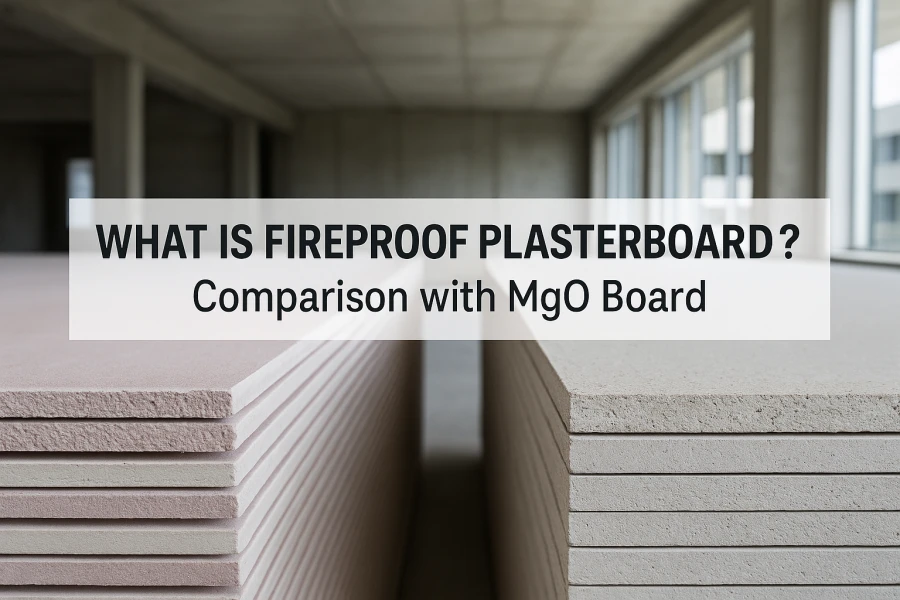
Fireproof Performance: Plasterboard vs MgO Board
When choosing between fireproof plasterboard and MgO board, one of the most important factors is how well each material performs under fire conditions. While both are designed to resist fire, their behaviors and limits differ significantly.
Fire Resistance Ratings
Fireproof plasterboard is tested to achieve specific fire ratings, often ranging from 30 to 60 minutes depending on thickness and reinforcement. It slows down heat transfer by releasing water vapor from gypsum when heated, which helps delay fire spread. However, its effectiveness can be compromised if the board is wet or installed improperly.
MgO board, in contrast, is non-combustible and maintains its structural integrity even at much higher temperatures. It often surpasses standard fireproof plasterboard in fire tests, providing a more reliable barrier in high-risk areas.
Structural Stability During Fire
Plasterboard may soften, sag, or even crack under prolonged high temperatures, especially in humid conditions. MgO board, being inorganic and denser, remains stable and rigid, making it less likely to fail during a fire event. This stability can be crucial in protecting both occupants and the overall building structure.
Smoke and Toxicity
While fireproof plasterboard generally produces minimal smoke when burning, MgO board produces virtually no toxic gases, as it does not contain paper or chemical additives that can ignite. This property enhances safety in enclosed spaces and reduces the risk of smoke inhalation during emergencies.
Summary
In terms of fire performance, MgO board offers superior protection, particularly for projects with high fire safety requirements or in areas where prolonged heat exposure is possible. Fireproof plasterboard remains a viable option for standard applications, but it has clear limitations compared to MgO board.
Moisture Resistance Comparison
Moisture resistance is a key factor to consider when choosing between fireproof plasterboard and MgO board, especially in areas prone to high humidity or direct water exposure.
Plasterboard and Moisture
Fireproof plasterboard, while effective at slowing fire, is susceptible to moisture. Gypsum, the main component, can absorb water, leading to swelling, softening, or even mold growth if exposed to prolonged damp conditions. As a result, its use is generally limited to dry interior spaces unless additional waterproofing measures are applied.
MgO Board and Moisture
MgO board is naturally highly resistant to moisture. Its inorganic mineral composition prevents absorption and swelling, making it ideal for bathrooms, kitchens, basements, and coastal buildings. Even in humid environments, MgO board maintains its strength and dimensional stability, reducing the risk of structural damage over time.
Practical Implications
-
For standard interior walls in dry areas, fireproof plasterboard is usually sufficient.
-
For wet or humid spaces, MgO board offers better long-term performance and less maintenance.
-
Using MgO board in moisture-prone areas also reduces the risk of mold, making it safer for both occupants and the building.
Strength & Durability
When evaluating building materials, strength and long-term durability are essential considerations, especially for high-traffic or structural applications.
Fireproof Plasterboard
Fireproof plasterboard is relatively lightweight and easy to handle, which makes installation straightforward. However, its mechanical strength is limited. Over time, especially in areas exposed to impact or vibration, plasterboard can:
-
Crack or chip
-
Sag under its own weight if spans are too wide
-
Become brittle, particularly in damp conditions
While it performs well for standard partitions and ceilings, it may require frequent maintenance in demanding environments.
MgO Board
MgO board is significantly stronger and more durable than plasterboard. Its dense, inorganic composition and embedded fiberglass reinforcement give it high impact resistance and excellent structural stability. Key benefits include:
-
Minimal sagging or warping over time
-
High resistance to cracking or chipping
-
Longevity in both dry and humid environments
Summary
For areas where strength and durability are critical—such as commercial spaces, high-traffic corridors, or wet environments—MgO board clearly outperforms fireproof plasterboard. Its robust nature ensures a longer service life with less maintenance, making it a cost-effective choice in the long run.
Installation Differences
The installation process is another important factor when comparing fireproof plasterboard and MgO board. While both are panel-based systems, there are notable differences in handling, cutting, and fixing.
Fireproof Plasterboard
Fireproof plasterboard is lightweight and easy to cut, which makes it convenient for most construction teams. Key points include:
-
Cutting: Can be scored with a utility knife and snapped along the line.
-
Fixing: Standard drywall screws or nails can be used.
-
Joint treatment: Joints are taped and filled with joint compound, then sanded smooth.
This ease of installation contributes to its widespread use in residential and commercial interior walls and ceilings. However, care must be taken to avoid over-saturating the board, as moisture can weaken the material.
MgO Board
MgO board is denser and harder, which requires slightly different handling:
-
Cutting: A fine-toothed saw or power tools are recommended.
-
Fixing: Screws should be corrosion-resistant and installed with pre-drilled pilot holes if needed.
-
Joint treatment: Similar to plasterboard, but using cement-based or specialized MgO joint fillers ensures long-term durability.
While MgO board installation may require more effort and slightly more skill, its benefits in fire resistance, moisture stability, and strength often outweigh the additional work.
Summary
-
Fireproof plasterboard is ideal for quick, easy installations in standard interior projects.
-
MgO board requires more precise handling but provides superior performance in fire, moisture, and structural stability.
Environmental & Health Considerations
Choosing the right building material is not only about performance but also about environmental impact and occupant health. Both fireproof plasterboard and MgO board have distinct characteristics in this regard.
Fireproof Plasterboard
-
Materials: Made primarily from gypsum and paper, with added fire-resistant fibers or chemicals.
-
Environmental impact: Production consumes energy and resources, and disposal may contribute to landfill waste if not recycled properly.
-
Health considerations: Generally safe, but improper cutting can generate dust. In a fire, gypsum boards release minimal smoke, though paper liners may burn slightly.
MgO Board
-
Materials: Composed of natural minerals like magnesium oxide, magnesium chloride or sulfate, and lightweight fillers such as perlite or wood dust.
-
Environmental impact: MgO board is largely eco-friendly. Its raw materials are abundant, non-toxic, and its long service life reduces replacement frequency.
-
Health considerations: Inorganic and non-combustible, it produces virtually no toxic fumes in fire. Dust from cutting is minimal compared to plasterboard, and the board does not support mold growth.
Summary
From an environmental and health perspective, MgO board offers clear advantages. Its inorganic composition, durability, and resistance to mold make it safer and more sustainable, particularly in residential or high-humidity applications.
Cost Comparison
Cost is always a key consideration when selecting building materials. While both fireproof plasterboard and MgO board serve similar functions, their pricing and long-term value can differ significantly.
Material Cost
Fireproof plasterboard is typically more affordable upfront, making it a popular choice for standard interior walls and ceilings. Its widespread availability and simple manufacturing process contribute to lower initial costs.
MgO board, on the other hand, usually comes at a higher material cost due to its superior fire resistance, moisture tolerance, and durability. The raw minerals and production process are more expensive, which can make the initial investment noticeably higher.
Installation and Labor
Plasterboard is lightweight and easy to install, so labor costs are generally lower. Standard tools and skills are sufficient, which speeds up construction and reduces overhead.
MgO board is heavier and harder, requiring more careful cutting, specialized tools, or corrosion-resistant screws. Installation may take slightly longer, and skilled labor is recommended, which can increase the overall cost.
Long-Term Value
While MgO board has a higher upfront cost, its durability, moisture resistance, and low maintenance make it a cost-effective choice over the long term. Fewer replacements, repairs, or mold mitigation efforts can offset the initial investment, especially in demanding environments.
Summary
-
Fireproof plasterboard: Lower upfront cost, easier installation, suitable for dry interior projects.
-
MgO board: Higher upfront cost, more labor-intensive installation, but greater longevity and reliability, particularly in wet or fire-sensitive areas.
Which One Should You Choose?
Choosing between fireproof plasterboard and MgO board depends on the specific requirements of your project, including fire safety, moisture levels, strength, and budget.
For Standard Interior Walls
If your project involves dry, residential or office interiors where fire safety requirements are moderate, fireproof plasterboard is usually sufficient. Its low cost, ease of installation, and familiarity to contractors make it a convenient choice for most standard applications.
For High-Humidity or Wet Areas
For bathrooms, kitchens, basements, or coastal buildings, MgO board is the better option. Its moisture resistance and structural stability prevent warping, swelling, and mold growth, ensuring a longer-lasting installation.
For High Fire-Risk Areas
If fire safety is a critical concern—such as in commercial corridors, public buildings, or areas with strict fire regulations—MgO board provides superior fire resistance. Its non-combustible nature and ability to maintain structural integrity under extreme heat make it the safer choice.
Balancing Cost and Performance
While MgO board has a higher upfront cost and requires more careful installation, the long-term benefits often outweigh the initial expense, especially for projects demanding durability, moisture resistance, and fire safety. Fireproof plasterboard remains a practical choice for budget-sensitive projects with lower environmental stress.
Conclusion
Both fireproof plasterboard and MgO board serve important roles in modern construction, offering fire resistance and contributing to safer interiors. However, their performance, durability, and suitability vary depending on the environment and application.
Fireproof plasterboard remains a reliable and cost-effective choice for standard interior walls and ceilings in dry areas. Its ease of installation and widespread availability make it a practical option for most residential and commercial projects.
MgO board, by contrast, excels in fire resistance, moisture tolerance, and structural strength. It is particularly well-suited for humid environments, high-traffic areas, and projects with strict fire safety requirements. Though it comes with a higher upfront cost and slightly more complex installation, its long-term benefits often justify the investment.
Ultimately, selecting the right material depends on your project needs, environmental conditions, and budget. By understanding the strengths and limitations of both options, you can make an informed decision that ensures safety, durability, and long-lasting performance.