Magnesium oxide board (MgO board) is widely known for its excellent fire resistance and durability. However, beyond its core performance, MgO board also serves as a high-quality substrate for various surface finishes.
In many real-world projects, MgO boards are not used as bare panels. Instead, they are combined with decorative or functional surface layers to meet specific design and performance requirements.
In this article, we’ll explore the most common MgO board surface finishes, their applications, and key technical considerations when choosing the right option.
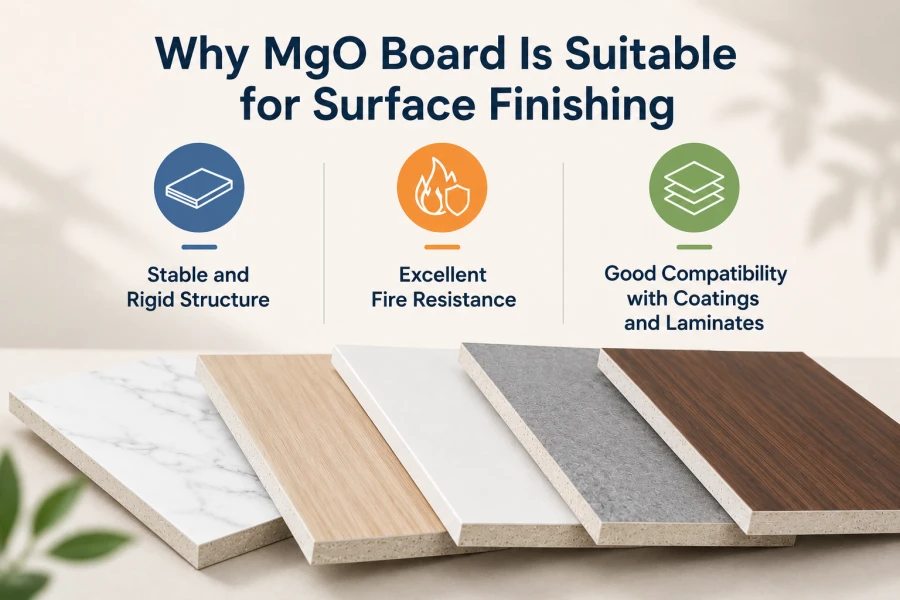
Why MgO Board Is Suitable for Surface Finishing
MgO board provides an ideal base for lamination and coating due to its unique material properties.
1. Stable and Rigid Structure
MgO boards maintain dimensional stability under different environmental conditions. This helps prevent issues such as:
- Warping
- Cracking
- Delamination
A stable substrate is essential for ensuring long-term performance of any surface finish.
2. Excellent Fire Resistance
Unlike many wood-based boards, MgO board is inherently non-combustible.
This makes it particularly suitable for:
- Public buildings
- Commercial interiors
- Fire-rated wall systems
Surface finishes applied to MgO board can benefit from this fire-resistant base.
3. Good Compatibility with Coatings and Laminates
With proper surface preparation (such as sanding), MgO boards can bond well with a wide range of finishing materials.
This flexibility allows manufacturers to produce customized panels for different markets and applications.
Common Types of MgO Board Surface Finishes
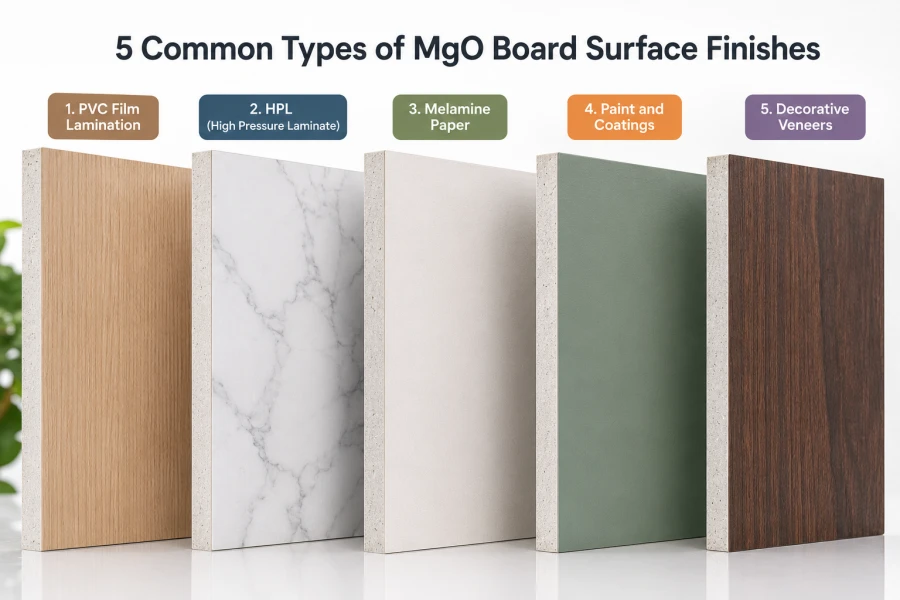
Different finishes offer different aesthetics and performance. Below are the most widely used options.
1. PVC Film Lamination
PVC laminated MgO board is one of the most common decorative solutions.
Key features:
- Water-resistant surface
- Easy to clean
- Wide range of colors and patterns (wood grain, marble, solid colors)
- Suitable for interior wall panels
Applications:
- Residential wall decoration
- Commercial interiors
- Prefabricated housing
Technical note:
Magnesium chloride-based MgO boards generally show better compatibility with PVC lamination, especially in terms of bonding performance and surface adhesion.
2. HPL (High Pressure Laminate)
HPL is a high-performance decorative laminate commonly used in demanding environments.
Key features:
- High impact resistance
- Scratch-resistant surface
- Hygienic and easy to maintain
- Excellent durability
Applications:
- Hospitals and clinics
- Laboratories
- High-traffic commercial areas
HPL laminated MgO boards are often chosen for projects that require both aesthetic quality and long-term durability.
3. Melamine Paper
Melamine-faced MgO board is a cost-effective option for certain applications.
Key features:
- Lightweight decorative finish
- Lower cost compared to HPL
- Smooth surface
Applications:
- Furniture backing panels
- Cabinet interiors
- Low-cost interior solutions
4. Paint and Coatings
Painting is the simplest and most flexible finishing method.
Key features:
- Easy on-site application
- Flexible color selection
- Suitable for large surfaces
Applications:
- Interior walls
- Ceilings
- Renovation projects
For best results, the board surface is usually sanded and primed before painting.
5. Decorative Veneers (Optional)
In premium applications, MgO boards can also be laminated with natural wood veneer or other decorative materials.
Key features:
- High-end appearance
- Natural texture
- Customizable finishes
Applications:
- Luxury interiors
- Feature walls
- Architectural design projects
Applications of Laminated MgO Boards
By combining MgO boards with different surface finishes, manufacturers can create products tailored for specific environments.
Typical applications include:
- Residential buildings – PVC or painted boards for walls and ceilings
- Schools and universities – Durable, easy-to-clean surfaces
- Hospitals and clinics – HPL finishes for hygiene and durability
- Commercial spaces – Decorative panels for offices, retail, and public areas
In these environments, both appearance and performance are critical, making laminated MgO boards a practical solution.
Key Technical Considerations
Choosing the right surface finish is not just about appearance—it also involves technical compatibility.
1. Surface Preparation
The board surface should be:
- Smooth
- Properly sanded
- Free of dust
This ensures better adhesion between the board and the finishing material.
2. Moisture Content
Moisture levels must be controlled before lamination.
Excess moisture can lead to:
- Poor bonding
- Surface defects
- Long-term performance issues
3. Adhesive Selection
Different finishes require different adhesives.
For example:
- PVC → PUR or hot-melt adhesives
- HPL → stronger structural adhesives
Choosing the right adhesive is critical for durability.
4. Board Chemistry (MgCl₂ vs MgSO₄)
The chemical composition of MgO boards can affect compatibility with finishes.
- Magnesium chloride boards: generally better bonding performance with PVC
- Magnesium sulfate boards: improved moisture resistance but may require different lamination approaches
Understanding this difference is important when selecting materials for specific applications.
MgO Board vs Other Substrates
Compared to traditional substrates, MgO board offers several advantages for surface finishing.
| Feature | Gypsum Board | Cement Board | MgO Board | Notes |
|---|---|---|---|---|
| Surface stability | Moderate | High | High | Stable surface improves lamination performance |
| Fire resistance | Good | Good | Excellent | Suitable for fire-rated applications |
| Lamination compatibility | Limited | Moderate | Excellent | Supports PVC, HPL, coating and veneer |
| Environmental profile | Moderate | Good | Excellent | Low emissions, no formaldehyde or asbestos |
MgO board provides a balanced combination of strength, fire resistance, and finishing flexibility, making it a preferred choice in many modern construction projects.
Conclusion
MgO board is not just a fireproof building material—it is also a versatile substrate for a wide range of surface finishes.
From PVC films and HPL laminates to paint and decorative veneers, MgO boards can be customized to meet different design and performance requirements.
By choosing the right combination of board type and surface finish, it is possible to achieve:
- Better durability
- Improved aesthetics
- Enhanced indoor air quality
If you are looking for customized laminated MgO boards for your project, feel free to contact us for more information or samples.
FAQ
Can MgO board be laminated with PVC?
Yes. PVC lamination is one of the most common applications for MgO boards, especially for interior wall panels.
Is HPL compatible with MgO board?
Yes. HPL can be applied to MgO boards, particularly in projects that require high durability and hygiene.
Do I need to sand MgO board before finishing?
In most cases, yes. Sanding improves surface smoothness and bonding performance.
Which MgO board is better for lamination?
It depends on the finish. Magnesium chloride boards often perform better with PVC lamination, while magnesium sulfate boards may be preferred in moisture-sensitive environments.
Can MgO board be painted directly?
Yes, but proper surface preparation (cleaning, sanding, priming) is recommended for the best results.